TradingCalc MCP: Options, Forex, Risk Stats, Prediction Markets, On-Chain & Cryp
Deterministic options, forex, risk, on-chain & futures math. 75 tools. Not AI estimates.
Connect it
Settings → Connectors → Add custom connector
URL: https://tradingcalc.io/api/mcpSettings → Apps & Connectors → Advanced → Developer mode
Create connector with URL: https://tradingcalc.io/api/mcp{
"mcpServers": {
"tradingcalc": {
"url": "https://tradingcalc.io/api/mcp"
}
}
}claude mcp add --transport http tradingcalc https://tradingcalc.io/api/mcp{
"servers": {
"tradingcalc": {
"type": "http",
"url": "https://tradingcalc.io/api/mcp"
}
}
}76 tools, verified live
workflow.run_pnl_planningread-onlyCalculate net PnL, ROE, fees and gross profit/loss for a futures trade. Use when user asks "what's my profit/loss on this trade?" Returns: grossPnl, fees, netPnl, netPnlUsdt, roe (%), maxLossBound (only non-null for an inverse/coin-margined short: the finite ceiling on net coin-denominated loss as price rises without limit, (size/entryPrice)×(1+feeOpenPct) - includes the opening fee, since it surv
workflow.run_liquidation_safetyread-onlyCalculate the liquidation price for an isolated-margin futures position. Use when user asks "where will I get liquidated?" or "how close is my liq price?". Returns: liquidationPrice, distancePct (how far from entry).
workflow.run_breakeven_planningread-onlyCalculate the break-even exit price that covers all trading fees: this alone, nothing else. Use when user asks only "what price do I need to just break even?" and nothing more. If the user also gave a stop/target or wants a full trade-safety check, use workflow.run_risk_reward or workflow.run_pre_trade_check instead; both already include this breakeven figure plus more. Returns: breakevenPrice, to
workflow.run_position_sizingread-onlyCalculate the correct position size given a maximum risk in USDT and a stop-loss price. Use when user asks "how many coins should I buy?" or "size my position so I risk exactly $X". Returns: positionSize (base), positionUsdt, marginRequired.
workflow.run_funding_costread-onlyCalculate the total funding cost (or income) for holding a perpetual futures position. Use when user asks "how much funding will I pay holding X days?" or "is funding eating my profit?". Returns: totalFundingUsdt (negative = you pay, positive = you receive), perIntervalUsdt.
primitive.average_entryread-onlyCalculate the weighted average entry price from multiple buy/sell fills (DCA): the bare number only, no breakeven or per-fill breakdown. Use when user asks only "what's my average entry?" and wants just that figure. For breakeven and a per-level summary too, use workflow.run_dca_entry instead. Returns: averagePrice, totalSize, totalCost.
workflow.run_exit_targetread-onlyCalculate the exact exit price needed to hit a target PnL or ROE percentage. Use when user asks "at what price do I take profit to make $500?" or "where should I set TP for 20% ROE?". Returns: targetExitPrice.
workflow.run_scenario_planningread-onlyRun a scenario analysis: compute PnL for multiple price-change percentages at once. Use when user asks "show me my P&L if BTC moves -10%, -5%, +5%, +10%". Returns: array of { deltaPct, exitPrice, netPnl, roe }.
workflow.run_max_leverageread-onlyCalculate the maximum safe leverage based on account size, max acceptable drawdown, and asset daily volatility. Use when user asks "what's the max leverage I should use on BTC?" or "how much leverage is safe given 3% daily volatility?". Returns: maxLeverage, marginAtRisk.
primitive.hedge_ratioread-onlyCalculate the short perpetual futures position size needed to hedge a spot holding. Use when user asks "how much should I short to hedge my BTC?" or "what margin do I need for a 100% hedge?". Returns: hedgeNotional, requiredMargin, estimatedFundingCost.
workflow.run_funding_arbitrageread-onlyCalculate funding rate arbitrage profit: annualized yield, net profit, and breakeven days for a long/short basis trade across two exchanges: the bare numbers only, no plain-English verdict. For the same math plus a profitable/marginal/loss verdict, use workflow.run_carry_trade instead. Use when user asks "is this funding arb worth it?" or "how many days to break even on transfer fees?". Returns: n
workflow.run_compound_fundingread-onlyProject capital growth from reinvesting perpetual futures funding income (compounding carry). Use when user asks "how much will I make compounding 0.01% funding for 90 days?" or "what's my APY on this carry position?". Returns: finalCapital, totalEarned, apy, growthTable.
workflow.run_pre_trade_checkread-onlyFull pre-trade decision card: orchestrates position sizing, breakeven, liquidation, and funding cost in one call. Use when user describes a full trade setup and asks "should I take this trade?" or "run the numbers on this setup". Provide exchange+symbol to fetch live funding rate automatically. For an R:R-graded verdict on an entry, stop and target, see workflow.run_risk_reward. Returns: positionS
workflow.run_risk_rewardread-onlyFull risk:reward analysis: takes a trade with entry, stop, AND target (all three). Calculates R:R ratio, position size, liquidation price, breakeven, and P&L at both stop and target. Returns a verdict: strong (3:1+) / good (2:1+) / marginal / poor, specifically graded on the R:R ratio. For a full setup check tied to a live exchange/symbol (including funding cost), see workflow.run_pre_trade_check;
workflow.run_portfolio_riskread-onlyAggregates risk across multiple open positions in one call: total notional, total P&L, total margin in use, margin usage as a % of account balance (if given), and which single position sits closest to liquidation. Each position is computed through the same canonical PnL/liquidation math as the single-position tools, then rolled up. Linear (USDT-margined) positions sum into one USD total; inverse (
workflow.run_dca_entryread-onlyDCA entry planner: weighted average entry price, breakeven, and per-level contribution from multiple fill prices and sizes. Compared with primitive.average_entry, this one adds output for the case where breakeven or the per-level breakdown is also wanted, not just the bare average. Use when user bought at several prices and asks "what's my average entry?" or "where is my DCA breakeven?". Returns:
workflow.run_average_downread-onlyShould-I-average-down check: for an already-open position, compares adding more at a worse price against the always-available alternative of buying the same final total size fresh at today's price. Returns the new blended average entry, liquidation price and breakeven (before vs. after), margin_added (the actual cash/margin required for the add at this leverage, not the full notional), and three r
workflow.run_scale_outread-onlyScale-out planner: P&L, ROI, and cumulative P&L for each partial exit level. Use when user wants to take profit at multiple targets: "close 30% at $90k, 30% at $95k, 40% at $100k, what's my total P&L?". Returns: per-level pnl, weightedAvgExitPrice, totalRoi.
workflow.run_carry_traderead-onlyDelta-neutral carry trade (funding arbitrage) analysis, with a profitable/marginal/loss verdict on top of the same math primitive.funding_arb uses. Compared with primitive.funding_arb, this one adds output for the case where a plain-English verdict is wanted, not just the raw numbers. Use when user asks "is this carry trade worth it?": long on exchange A, short on exchange B, collect the funding r
workflow.run_funding_breakevenread-onlyPrice move needed to cover funding cost + fees over a holding period. Use when user asks "how much does BTC need to move for me to profit after funding?" or "is funding killing my edge on this trade?". Returns: breakevenWithFunding, breakevenWithoutFunding, requiredMovePct.
workflow.run_bonding_curveread-onlyPump.fun-style bonding curve calculator: exact tokens received for a buy, price impact, and graduation progress. Pure constant-product math (Uniswap V2 style) using pump.fun's official virtual-reserve constants: no live lookup needed, works for any token still on the curve (not yet graduated to a real AMM pool). Use when user asks "how many tokens do I get buying X SOL on this curve?" or "will thi
workflow.run_impermanent_lossread-onlyImpermanent loss for a liquidity-pool position: compares providing liquidity against simply holding the same tokens, at a manually-supplied entry and current price. Two modes: full_range (standard 50/50 constant-product pool, the textbook 2*sqrt(k)/(1+k)-1 closed form) or concentrated (a Uniswap-V3-style position confined to [lowerPrice, upperPrice] - IL is always worse than full_range for the sam
workflow.run_options_payoffread-onlyPayoff, P&L, and breakeven price for a single-leg Deribit BTC/ETH option (long or short call/put) at a given scenario price at expiry. Deribit BTC/ETH options are coin-settled: premium, P&L, and the max profit/loss caps come back denominated in the base coin (BTC/ETH), not USD; a scenarioPnlUsd convenience field converts the coin P&L back to USD at the scenario price. Coin settlement means a long
workflow.run_black_scholesread-onlyTheoretical European option price and Greeks (delta, gamma, theta, vega, rho) from Black-Scholes, given manual spot/strike/days-to-expiry/volatility/risk-free-rate inputs: no live data fetch. The live variant is workflow.run_black_scholes_live, which applies when checking a real Deribit BTC/ETH instrument, since that variant also reports how far the instrument's actual quoted price sits from what
workflow.run_straddle_strangleread-onlyPayoff, P&L, and both breakeven prices for a long or short straddle/strangle (a call + a put on the same Deribit BTC/ETH underlying, both legs the same direction) at a scenario price. A straddle is callStrike === putStrike; any callStrike > putStrike makes it a strangle, same formula either way. Coin-settled like workflow.run_options_payoff: a long position's max loss is the flat total premium pai
workflow.run_covered_call_protective_putread-onlyCovered call (long the coin + short a call against it, for yield) or protective put (long the coin + long a put, for downside insurance) on a Deribit BTC/ETH position. Returns the standard annualized-yield metric (premium ÷ 1 coin, annualized by 365/daysToExpiry) up front: that number doesn't depend on any price scenario. Also returns the USD value of the combined position at a given scenario pric
workflow.run_spread_payoffread-onlyPayoff, breakeven(s), and max profit/loss for a Deribit BTC/ETH vertical spread (2 legs, same option type, opposite direction, e.g. a bull call spread) or an iron condor/butterfly (4 legs: 2 calls + 2 puts) at a scenario price. Coin-settled, and the max profit/loss are genuinely NOT the flat, textbook USD-settled values: because each leg's own payoff is divided by the settlement price, (1) a debit
workflow.run_implied_volatilityread-onlySolves for the volatility that makes Black-Scholes reproduce an observed option price (Newton-Raphson with a bisection fallback for cases where vega is too flat to converge, e.g. deep ITM/OTM or very short-dated). Checks the price against its no-arbitrage bounds first and refuses to solve (converged: false + error) rather than return a garbage number when the price is impossible for the given spot
workflow.run_window_fair_valueread-onlyTheoretical fair value for a time-windowed crypto up/down contract (the shape ADI Predictstreet and Kalshi-style daily crypto markets use: pays out based on whether the settlement price finishes at/above or below a reference price pinned at window open, by a fixed close time): a cash-or-nothing digital option, priced with the standard N(d2) formula. Use this when there's no live market price to re
workflow.run_forex_pip_valueread-onlyValue of 1 pip for a given forex pair and position size, in that pair's own quote currency (e.g. EUR/USD's pip value comes back in USD, USD/JPY's in JPY): no live FX rate needed, since a pair's pip value is naturally denominated in its own quote currency. Pip size is 0.0001 for non-JPY pairs, 0.01 for JPY-quoted pairs, a universal market convention verified against real broker documentation, not b
workflow.run_forex_margin_levelread-onlyFree margin and margin level % from account equity and used margin: equity/usedMargin*100, the same stop-out proximity metric every forex platform shows. Returns null (not Infinity) when usedMargin is 0, meaning no open position. Use when user asks "how close am I to a margin call?" or "what's my free margin?". Returns: freeMargin, marginLevelPct.
workflow.run_forex_breakevenread-onlyBreakeven price for a forex position accounting for spread and round-trip commission, in pips and in price. Commission is quoted per standard lot (100,000 units) and expressed in the pair's own quote currency; because both commission and pip value scale with lot size, the commission-in-pips figure is independent of position size by construction. Use when user asks "where's my true breakeven after
workflow.run_forex_pnlread-onlyProfit or loss for a closed or hypothetical forex trade, in pips and in the pair's own quote currency, long or short. Use when user asks "what did I make/lose on this trade?" or "what would X pips be worth on Y lots?". Returns: pips (signed, positive favors the position taken), pnlQuote.
workflow.run_forex_risk_rewardread-onlyRisk and reward distance in pips from entry/stop/target, and the resulting ratio (reward/risk): a raw number, not a verdict. ratio is null when the stop sits exactly at entry (no risk distance), and also when validSetup is false (stop/target on the wrong side of entry for the given side, e.g. a long with its stop above entry) - check validSetup before trusting the ratio. Use when user asks "what's
workflow.run_forex_scenarioread-onlyPnL across a range of hypothetical price moves (in pips, signed by actual price direction, not pre-adjusted for side), for a single forex position size, long or short. Use when user asks "what if price moves X pips in either direction?". Returns: scenarios[] (deltaPips, exitPrice, pnlQuote).
workflow.run_forex_average_entryread-onlySize-weighted average entry price across multiple forex fills: plain arithmetic mean, since forex has no coin-margined analog requiring the harmonic mean the crypto average_entry tool uses for inverse contracts. Use when user asks "what's my average entry after these fills?". Returns: totalUnits, totalCost, avgEntry.
workflow.run_forex_margin_requiredread-onlyNotional and margin required for a forex position, in the pair's own quote currency: no live FX rate needed. Never built for Phase 1 of this domain since a margin figure has no natural currency-neutral form the way pip value does. The live variant is workflow.run_forex_margin_required_live, which applies when the account currency differs from the pair's quote currency. Use when user asks "how much
workflow.run_forex_currency_converterread-onlyConverts an amount between currencies using a manually supplied rate: no live data fetch. The live variant is workflow.run_forex_currency_converter_live, which has the rate fetched automatically. Use when user already knows the exact rate they want applied. Returns: converted.
workflow.run_forex_swap_costread-onlyTotal swap/rollover cost (or credit) for holding a forex position overnight, in the pair's own quote currency: no live FX rate needed. Swap rates are broker-set with no free live feed available, so swapPerLotPerNight is always a manual input (quoted per standard lot, matching how commission is quoted in workflow.run_forex_breakeven), not fetched. Negative = cost (you pay), positive = credit (you r
workflow.run_forex_correlationread-onlyCorrelation coefficient and minimum-variance hedge ratio between two price series of matching length, computed on daily % returns (not raw price levels, which would give spuriously high correlation between two unrelated but both-trending series). hedgeRatio follows Hull's standard futures-hedging formula: cov(returns1,returns2)/var(returns2), "how many units of series 2 per unit of series 1 minimi
workflow.run_var_cvarread-onlyParametric Value at Risk (VaR) and Conditional VaR / Expected Shortfall (CVaR), the variance-covariance method (assumes normally distributed returns), plus Modified VaR (Cornish-Fisher skew/kurtosis correction, Boudt/Peterson/Croux) when a return series is supplied. Supply either a return series or a mean/stdev pair directly, at a confidence level. Output is at the same periodicity as the input (n
workflow.run_sharpe_statsread-onlySharpe ratio with the Lo (2002) serial-correlation-aware annualization correction (the naive sqrt(periods_per_year) scaling overstates or understates the true annualized Sharpe when returns are autocorrelated), plus the Probabilistic Sharpe Ratio (Bailey & Lopez de Prado): the probability the true Sharpe exceeds a benchmark, adjusted for the sample's skewness/kurtosis and length, not just its poin
workflow.run_hurst_exponentread-onlyHurst exponent via rescaled-range (R/S) analysis: is this return/price series trending/persistent (H>0.5, a move tends to be followed by a move in the same direction), mean-reverting/anti-persistent (H<0.5), or consistent with a random walk (H~0.5)? Use when user asks "is this asset trending or mean-reverting?" or "does this series show long-range dependence?". Takes a return series, not raw price
workflow.run_cointegrationread-onlyEngle-Granger two-step cointegration test for a pair of price series: do they share a long-run equilibrium relationship (their spread is stationary/mean-reverting)? The standard pairs-trading signal test. Returns the cointegrating regression's hedge ratio (beta) and an ADF t-statistic on the residuals, compared against 1%/5%/10% critical values. Use when user asks "are these two assets cointegrate
workflow.run_portfolio_tearsheetread-onlyCore risk/return tearsheet from a single return series: annualized return (compounded, not linear) and volatility, Sharpe (plain + Lo 2002-corrected + Pezier-White skew/kurtosis-adjusted), Sortino, max drawdown, Calmar ratio, the drawdown-ratio cluster (Ulcer Index/Martin ratio, Pain Index/Pain ratio, Burke ratio + modified), Omega-Sharpe ratio, Upside Potential Ratio, skewness, kurtosis, Probabil
workflow.run_garchread-onlyGARCH(1,1) volatility model, fit by maximum likelihood on a return series: estimates omega/alpha/beta (the variance-persistence parameters) and forecasts next-period volatility. Use when user asks "what's my GARCH volatility forecast?" or "how persistent is volatility in this return series?". This is a backward-looking statistical fit, not a market prediction guarantee. Returns: mu, omega, alpha,
workflow.run_risk_parityread-onlyRisk-parity (equal or custom risk contribution) portfolio weights for N assets: given a covariance matrix (or N return series to compute one from), finds long-only weights where each asset contributes its target share of total portfolio risk. Use when user asks "what weights give each asset equal risk contribution?" or "how do I risk-parity-weight this portfolio?". A portfolio-construction calcula
workflow.run_dsrread-onlyDeflated Sharpe Ratio (Bailey & Lopez de Prado): given how many strategy variants you tried (and how correlated they are), what Sharpe ratio would the *best of N* clear by luck alone, and does your actual strategy still clear that higher bar? Use when user asks "is my backtested Sharpe ratio real, or did I get lucky trying many variants?" or "how many independent trials does this really represent?
workflow.run_kelly_frontierread-onlyKelly growth-security frontier (MacLean, Ziemba & Blazenko 1992): for a strategy compounding at a fraction lambda of full Kelly, the probability wealth ever falls to a fraction alpha of its starting value is P = alpha^(2/lambda-1). Provide either lambda_fraction (to compute that probability) or max_probability (to solve for the largest lambda that keeps the ruin probability at or below it). Use wh
workflow.run_unsmoothingread-onlyReturn "unsmoothing" for infrequently-marked/illiquid or appraisal-based series: Getmansky-Lo-Makarov (2004) MA(2) smoothing index plus Blundell-Ward (1987) AR(1) volatility inflation, two complementary models answering "this return series looks smoother than it really is; what's the true volatility?". Use when user asks "how much is appraisal smoothing understating my real volatility?" or "what's
workflow.run_evt_tail_riskread-onlyExtreme Value Theory tail risk (Peaks-Over-Threshold): fits a Generalized Pareto Distribution to the losses beyond a high threshold via Grimshaw's (1993) profile-likelihood MLE, then extrapolates VaR/Expected Shortfall at the requested confidence, without assuming a normal distribution. Use when user asks "what's my tail VaR without assuming normality?" or "how fat is my loss tail, really?". Compl
workflow.run_orderbook_impactread-onlyOrder-book "walk the book" impact/capacity: given order-book levels (price, size in base-asset units) and EITHER a target notional or an impact budget in bps, computes VWAP and price impact for that size, or (via bisection) the largest notional that stays inside the impact budget. Use when user asks "what's my price impact if I trade $X" or "how much can I trade before impact exceeds Y bps". side=
workflow.run_open_analysisread-onlyMarket Profile open analysis: where and how price opened vs the prior session value area. Use for "how did BTC open today?" / "what does the open imply for the session?". Returns: open_location, open_type (OD/OTD/ORR/OAIR) with description/implication, confidence, key_levels (VAH/VAL/VPOC/IB), tails (session-high/low rejection tails and single prints), scenario_framing (bullish/bearish/neutral), i
workflow.run_session_structureread-onlyMarket Profile day-type classifier: trend / balance / neutral_trend / normal / normal_var, from TPO, initial balance, range extension and value migration. Use for "is this a trend day or a balance day?". Returns: structure (the day-type label), description, bias, key_signals, key_levels (VAH/VAL/VPOC/IB/session high-low), tails (session-high/low rejection tails and single prints), scenario_framing
workflow.run_value_migrationread-onlyMarket Profile value-area migration across sessions: is value migrating up, down, or overlapping (directional conviction vs balance)? Use for "is value moving higher day over day?". Returns: state, direction, migration_pct, key_levels (current vs. prior session VAH/VAL/VPOC), tails (session-high/low rejection tails and single prints), scenario_framing, invalidation level.
workflow.run_breakout_acceptanceread-onlyMarket Profile breakout acceptance: did price accept (hold) beyond the value area / range, or reject back inside (fakeout)? Optional buy/sell delta. Use for "did the break above VAH get accepted?". Returns: state, accepted (boolean), direction, confidence, key_levels (VAH/VAL/VPOC), scenario_framing, invalidation level.
workflow.run_token_risk_checkread-onlyToken rug-pull MECHANISM check for a Solana token (mint address): can the deployer still mint supply, freeze wallets, pull liquidity, swap metadata, or has RugCheck flagged a known scam pattern (e.g. copycat token)? Fetches live facts from RugCheck (GoPlus as fallback) and returns a transparently-weighted composite score. Deliberately does NOT score holder concentration or "whale dump" impact: tho
workflow.run_swap_price_impactread-onlyLive price-impact quote for a Solana token swap: routed through Jupiter (the same aggregator real swaps use) across every pool it knows about, not a single-pool estimate. Use when user asks "how much slippage will I eat swapping X tokens?" or "what will I actually get if I sell N tokens?". Returns: outputAmount, priceImpactPct, effectivePrice, marketPriceUsd, liquidityUsd, routable (false + error
workflow.run_market_cap_comparisonread-onlyCompares two tokens' live market caps (Solana or any of 5 EVM chains; the two tokens can be on different chains) and projects what an investment would be worth if the first token's market cap matched the second's. Narrative-agnostic ("if X reaches Y's market cap"): works for any token pair, not tied to one hype cycle or one chain. A snapshot ratio, not a forecast: assumes fixed supply on both side
workflow.run_impermanent_loss_liveread-onlyLive variant of workflow.run_impermanent_loss: fetches each token's current live USD price (Solana or any of 5 EVM chains) and derives currentPrice as their ratio, instead of it being supplied manually. entryPrice stays a manual, historical input (a fact the caller must supply, not something a live quote should overwrite), same convention as every other live-capable tool in this product. Use when
workflow.run_wallet_flag_checkread-onlyChecks a wallet address (Solana or any of 5 EVM chains) against independent flag databases: GoPlus (malicious-address categories, all chains), Webacy (address analysis + sanctions check, all chains), and ScamSniffer (public phishing/drainer blacklist, EVM chains only), and returns each source's own facts separately, never merged into one invented score. Use when user asks "is this wallet address f
workflow.run_odds_converterread-onlyConverts a probability into decimal odds, American odds, and breakeven win rate: either from a manually supplied probability, or fetched live from Kalshi, Polymarket, ADI Predictstreet, Limitless, or Myriad (five independent crypto-price prediction market venues, all public keyless market data). When a Kalshi, Polymarket, Limitless, or Myriad source is supplied, also returns the vig (the exchange'
workflow.run_spread_readerread-onlyReads the same real-world bet's live price from 2-5 prediction-market venues at once (Kalshi, Polymarket, ADI Predictstreet, Limitless, Myriad) and reports the spread between the cheapest and most expensive. The caller supplies each venue's own identifier for what they've confirmed is the same underlying bet; this tool never auto-matches events across venues, only reads and compares prices for ide
workflow.run_cross_venue_arbitrageread-onlyChecks 2-5 quotes for the SAME real-world binary bet across venues (or manually-supplied probabilities) for a guaranteed, direction-independent arbitrage: buy "Yes" at whichever venue quotes it cheapest, buy "No" at whichever venue quotes "Yes" most expensively (its own "No" price is assumed to be 1 minus its own "Yes" price, the standard complementary-binary convention). Reports isArbitrage, the
workflow.run_market_implied_oddsread-onlyReads Kalshi's full live BTC or ETH year-end price ladder (a set of mutually-exclusive prediction markets covering the whole price range) and reports what the market itself implies: the median (50th-percentile) price bucket, the single most-likely (mode) bucket, and the probability of ending the year at or above any real bucket boundary. Deliberately does not compute an expected value or interpola
workflow.run_black_scholes_liveread-onlyBlack-Scholes theoretical price and Greeks for a REAL, live Deribit BTC/ETH option instrument: pulls that instrument's own spot, strike, days to expiry, and implied volatility from Deribit, then reports how far Deribit's actual quoted mark price sits from what Black-Scholes implies at that IV (priceDiscrepancyPct). This is the trust-check tool: "is this exchange's quoted price consistent with its
workflow.run_forex_pip_value_liveread-onlyValue of 1 pip for a forex pair and position size, converted to a given account currency via a live FX rate: TrueFX for its 10 quoted majors (genuinely live tick data), frankfurter.app daily ECB reference rate as the fallback for every other currency (30 total). Use when user asks "what's 1 pip worth in my account currency?" and the account currency differs from the pair's own quote currency (if i
workflow.run_forex_margin_required_liveread-onlyNotional and margin required for a forex position, converted to a given account currency via a live FX rate (same TrueFX/frankfurter.app source as workflow.run_forex_pip_value_live). Use when user asks "how much margin do I need in my account currency?" and the account currency differs from the pair's own quote currency. Returns everything workflow.run_forex_margin_required does, plus accountCurre
workflow.run_forex_position_size_liveread-onlyPosition size (units and standard lots) from a risk amount and stop distance, in a given account currency, via a live FX rate to convert pip value into that currency (same TrueFX/frankfurter.app source as the other forex _live tools). Never has a meaningful account-currency-agnostic form: sizing a position from a risk budget genuinely requires knowing what 1 pip is worth in the currency that budge
workflow.run_forex_currency_converter_liveread-onlyConverts an amount between currencies using a live FX rate: TrueFX for its 10 quoted majors (genuinely live tick data), frankfurter.app daily ECB reference rate as the fallback for every other currency pair (30 total). Use when user asks "what's $X worth in EUR?" or any currency conversion where the rate itself isn't already known. Returns: converted, rate, source (truefx/frankfurter/identity), as
workflow.run_forex_swap_cost_liveread-onlyTotal swap/rollover cost (or credit) for holding a forex position overnight, converted to a given account currency via a live FX rate (same TrueFX/frankfurter.app source as the other forex _live tools). swapPerLotPerNight is still always a manual input: swap rates are broker-set, with no free live feed available for them. Use when user asks "how much will holding this position overnight cost me in
workflow.run_forex_correlation_liveread-onlyCorrelation coefficient and minimum-variance hedge ratio between two forex pairs, fetched live: historical daily rates for both pairs over the given lookback window (frankfurter.app's daily ECB reference time series, business days only), aligned by matching date, computed on daily % returns. hedgeRatio follows Hull's standard futures-hedging formula: "how many units of pair2 per unit of pair1 mini
workflow.run_price_consensusread-onlyCross-exchange agreement check for one perpetual futures price: fetches the same asset USDT/USDC-margined perpetual from a reference set of 7 liquid exchanges (Binance, Bybit, OKX, Gate, KuCoin, Hyperliquid, MEXC; the chosen one is compared against the rest) and reports the median of the others, the spread across all, and how far the chosen exchange sits from that median. Says the exchanges disagr
workflow.run_prediction_market_edgeread-onlyCompares your own probability estimate for an event against a prediction market's price (manual entry, or a live Kalshi ticker, Limitless slug, or Myriad slug) and sizes a bet using fractional Kelly criterion bet sizing (default: quarter-Kelly, a standard conservative haircut on full Kelly, stated explicitly as a convention). Returns zero recommended stake whenever your probability doesn't exceed
system.verifyread-onlyRun the full regression suite: 43 canonical test vectors (linear and inverse/coin-margined) across all 12 calculators, and return a pass/fail report with counts and timestamp. Useful as a health check before relying on results in production workflows.
system.pubkeyread-onlyReturn the ECDSA P-256 public key (PEM + JWK) and canonical signing format used to sign tool responses, so results can be verified offline without calling back to TradingCalc. Every tools/call result includes a signed second content block when signing is configured; also available at GET /api/mcp/pubkey.
Alternatives in Finance & Payments
Compare →STStripeOfficialA
MCP server integrating with Stripe - tools for customers, products, payments, and more.
DEDexPaprikaA
DEX and on-chain data: liquidity pools, token prices, swaps, and trading volume.
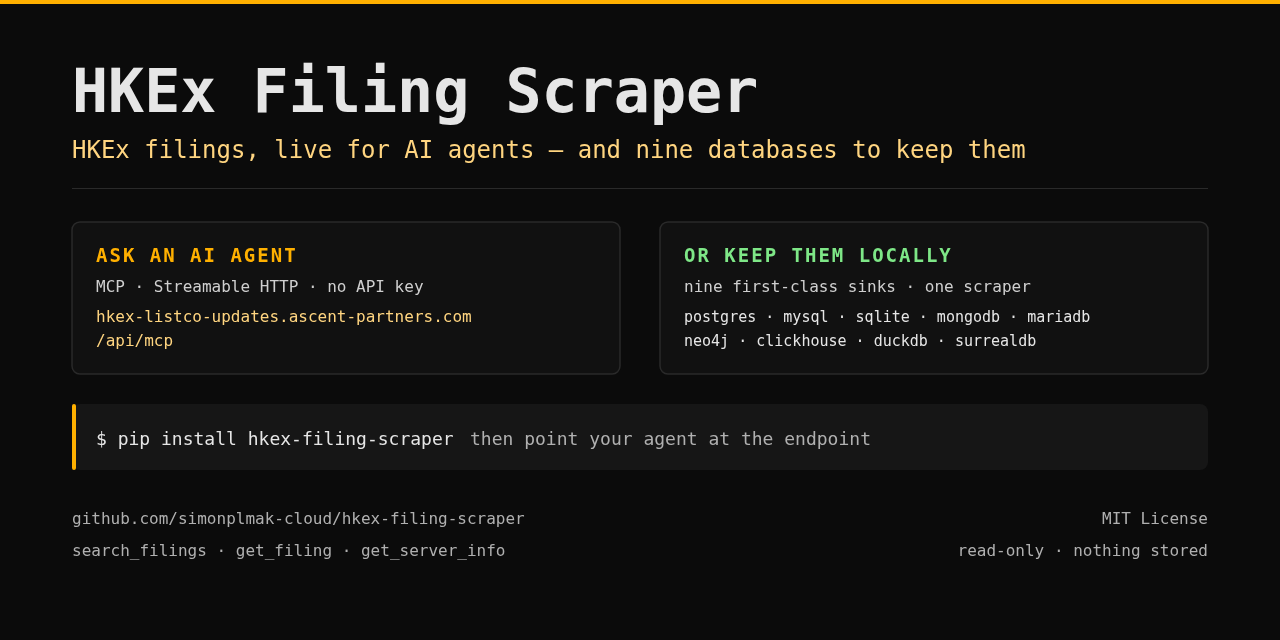 HKEx FilingsA
Live HKEx (Hong Kong Stock Exchange) regulatory filings for AI agents.
 PayRamA
Install, configure, operate and integrate self-hosted PayRam crypto payment gateways.
 PreReasonA
Financial market context for AI agents: macro, rates, bonds, FX, commodities, companies and Bitcoin.
 Beancount.ioA
Query, edit, and reconcile a hosted Beancount ledger: BQL, reports, files, and bank imports.